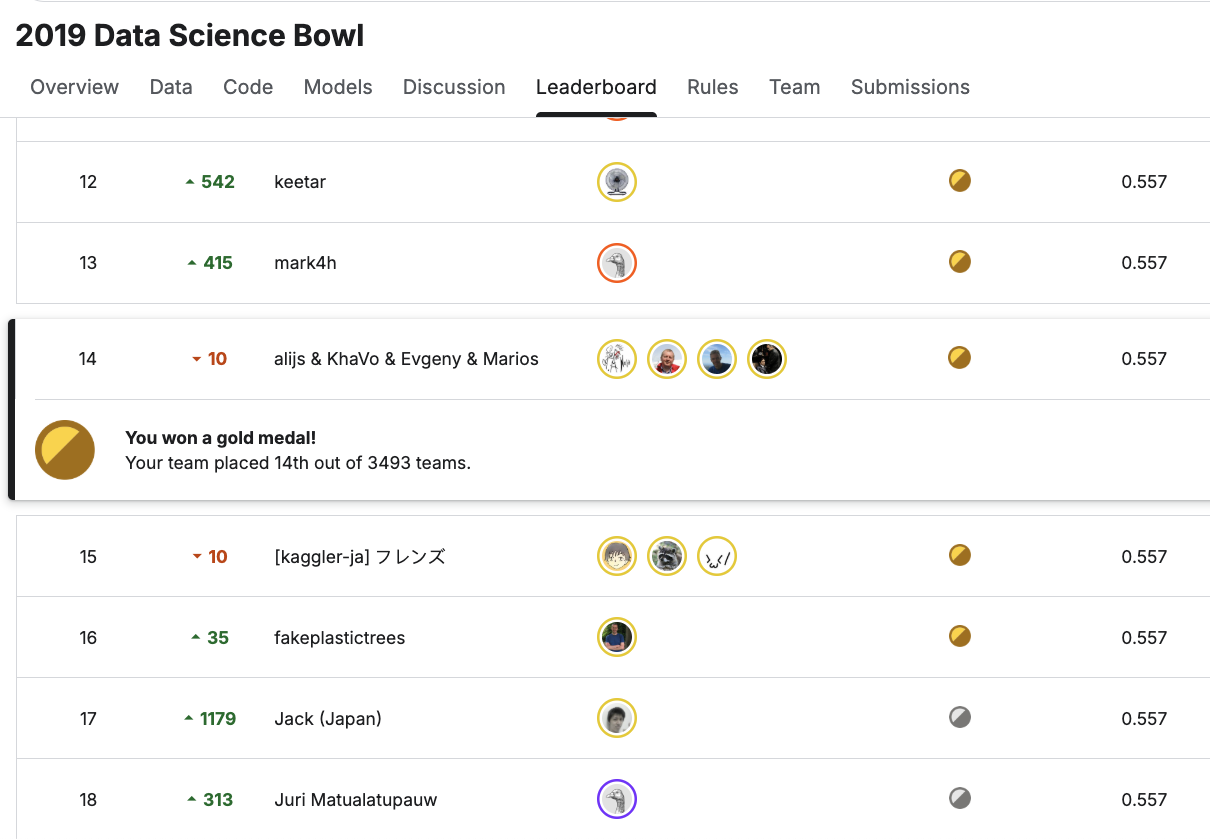
(Rank 14/3493) Ensemble zoo never disappoints!
by Kha Vo
I was extremely proud to lead a team of great talents to an outstanding success: a gold medal (rank 14/3494) in the big annual Data Science Bowl tradition on Kaggle! Find my posted write-up and code here:
🏆 Data Science Bowl 2019 — Competition Overview
The Data Science Bowl 2019 was a Kaggle competition focused on measuring how children learn through gameplay. Participants were given detailed event logs from an educational game and asked to predict how well a child would perform on future assessments.
🎯 Goal
The objective was to predict an accuracy group (0–3) for each assessment attempt, representing how successfully a player completed a task. This is a multi-class ordinal prediction problem, where understanding player behavior over time is crucial.
📊 Data
The dataset consisted of event-level logs capturing everything a player did inside the game:
-
Session types (Game, Activity, Assessment)
-
Event codes, actions, timestamps
-
Installation IDs representing individual users
Each user’s history formed a sequence of interactions, making the problem a mix of behavioral analytics, temporal modeling, and feature engineering.
[ Game → Activity → Game → Assessment → Game → Assessment ] \br \br
📐 Evaluation Metric
Submissions were scored using Quadratic Weighted Kappa (QWK) — a metric that:
Rewards correct predictions
Penalizes larger mistakes more heavily than smaller ones This made it especially important to get “almost right” predictions rather than just maximizing raw accuracy. \br \br
🧠 Our Solution
Before diving in, I want to sincerely thank Kaggle for hosting such a well-designed competition, and my amazing teammates @alijs1, @johnpateha, and @kazanova. Working together was both challenging and genuinely fun — one of my most enjoyable Kaggle experiences.
Below is a high-level summary of our approach.
🔧 Feature Engineering: Where the Magic Started
Beyond common public features, we focused heavily on behavior-driven signals, including:
Ratios of good actions vs. all actions during Activity sessions
Misclick and misdrag rates normalized by action count or session duration
Counts of specific event codes since the previous Assessment
Assessment-aware statistics: features computed relative to the same assessment type across a user’s history
These assessment-specific statistics turned out to be especially powerful. They helped tree models converge faster and reduced over-reliance on assessment titles.
In parallel, Marios (@kazanova) built an alternative feature set designed explicitly to handle train–test mismatch, which added valuable diversity to our final blend.
🔁 Data Augmentation: Free Data Hidden in Plain Sight
One of our biggest “aha” moments was realizing that test users often had past assessments.
If a test installation_id had prior assessments, we could:
Truncate the user’s history
Treat earlier assessments as additional labeled training samples
This simple idea massively expanded our effective training set and became a key contributor to our final performance, especially in ensembling.
🤖 Modeling Strategy
We used two main modeling tracks:
-
Model 1 — Global Model: A single model trained across all assessments, using the full dataset.
-
Model 2 — Assessment-Specific Models: Five separate models, each trained on one assessment type, whose predictions were later combined.
With data augmentation enabled, this gave us four distinct training strategies, which provided excellent diversity for ensembling.
Thresholding
Rather than obsessing over threshold tuning, we used a simple CV-based optimizer and focused our effort on better modeling and blending, where the real gains were.
⚖️ Sample Weights: Matching the Real World
We observed strong leaderboard gains by applying sample weights based on the number of prior assessments a user had completed.
However, weighting wasn’t trivial:
Samples from the same user are highly correlated
Overweighting frequent users can distort training
In the end, we used a heuristic weighting scheme, roughly decreasing weights as prior assessments increased. While not theoretically perfect, it worked surprisingly well on the leaderboard.
🧩 Ensembling: Where Everything Came Together Custom Classifier Logic
Instead of averaging predictions, we built a rule-based ensemble:
- Train three binary classifiers to distinguish between adjacent classes (0/1, 1/2, 2/3)
- Use these classifiers to resolve disagreements between Model 1 and Model 2
- This hybrid logic-based approach turned out to be one of our strongest techniques.
Stacking
We also experimented with stacking:
-
Averaging multiple stackers
-
Extra Trees Regressor as a meta-model
Extra Trees performed very well in CV and private LB, but we ultimately submitted a blend of classifier logic + stacking, which unfortunately underperformed in private LB.
🔍 What Worked (and Didn’t)
Worked in Private LB (but not Public):
-
Histogram matching using public LB prediction distributions
-
Extra Trees stacking (this would’ve landed us even higher)
Didn’t Work:
-
Ranking-based averaging
-
Pseudo-labeling unused training IDs (great CV, worse LB)
Didn’t Finish in Time
-
We also built an RNN model that modeled session sequences using event-code counts
-
Combined sequence features with dense engineered features
It achieved strong CV results and would likely have boosted our final score — but it was completed too late to integrate cleanly.
🧠 Final Reflections
This was my first time working with three Kaggle Grandmasters in a major competition — an incredible learning experience. A few things that stuck with me:
-
Diversity beats elegance in Kaggle
-
Public LB is a mystery — don’t trust it too much
-
Merging late is painful, but worth it if ideas are diverse
-
Long kernel runs that fail at the last minute… build character 😄
We’re proud to be one of only three teams to maintain gold throughout the competition. The final result was a mix of hard work, teamwork, and a bit of luck — and we’ll happily enjoy that gold medal.
Thanks for reading, and I hope you enjoyed this recap.
This is the entire code solution written by me (embedded below, separate link here)